Sign up for our Newsletter
Our monthly newsletter lists our upcoming events, reviews, news from the Town House, history features and snippets, plus a local exhibition listing.
Contact Us
The Regency Town House
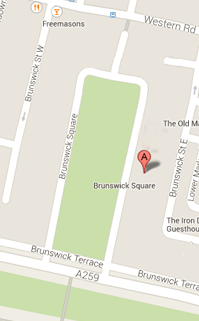
13 Brunswick Square
Brighton & Hove
East Sussex
BN3 1EH, UK
9 Brunswick Street West
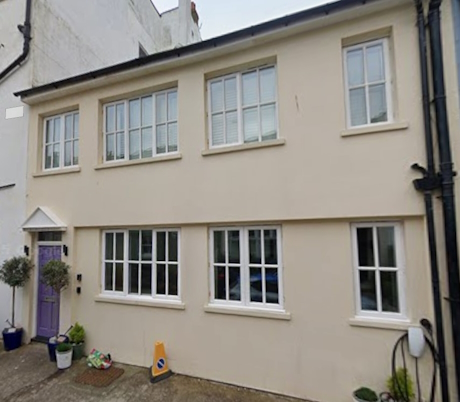
9 Brunswick Street West from Google Streetview June 2023
Number 9 Brunswick Street West was, before the 1924 renumbering of the street, number 27. The building started life as the stable block for the grand house at 27 Brunswick Terrace, being built in the 1820s. It remained as a stable block for the first one hundred years of its life although it doesn’t appear to have been used much for stabling during that period.
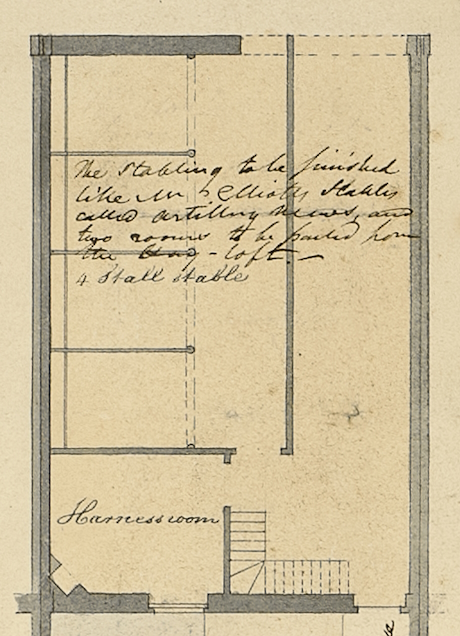
Charles Augustin Busby’s design for a Brunswick town stable block
The grand house was owned from around 1825 until 1853 by Sir Edward Kerrison who fought under the Duke of Wellington at the Battle of Waterloo. Kerrison also gave his name to the upmarket inn at the bottom of Waterloo Street where the Brunswick Commissioners first met.
Kerrison also maintained a London property which was not unusual for owners or visitors to Brunswick Town. The newspapers document his comings and goings from 27 Brunswick Terrace.
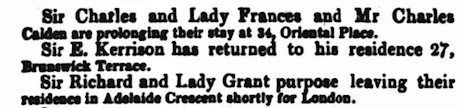
Brighton Gazette from 1 April 1852
Throughout the nineteenth century many of the houses on Brunswick Terrace were leased to visitors who were coming to Brighton for ‘the season’, which lasted from July until March the following year.
After Kerrison’s death at the age of 76 on 9 March 1853 the house was leased by William Rutty. The lease, for two hundred and thirty pounds a year, includes the stables as the document makes clear in the final paragraph:
“Stabling – Room over coach house – 1 rail, 6 pegs, 24 inch Forest Range and 1 rail and 7 pegs in room over harness room – 20in Forest Range. 4 carriage racks, 4 iron pegs in harness room. 2 shelves and 6 wood pegs in stable. Slate, cistern and taps.”
The censuses make no mention of the stable in 1841, 1851 or 1861. It may be that visitors, rather than bringing their own stable staff, horses and carriages, made use of the various livery stables close by. There was a large livery stable exactly opposite the stable of number 27 in Brunswick Street West.
Our stable block does get a mention in the newspapers in 1852 and this might explain what was going on.
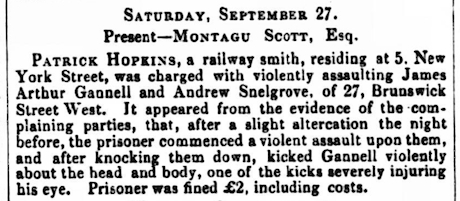
Brighton Gazette of 2 October 1852
James Arthur Gannell was a carpenter who was living in Tidy Street, Brighton in the previous year and Andrew Snelgrove was possibly a petty thief from Gloucestershire. There is no evidence that either were employed in the business of horse-drawn transport so it’s possible that, with the stables unused by the owners or visitors, the building was rented out as storage and accommodation.
The residents of the stable wouldn’t have had a great September as they would have been disrupted by a huge fire which nearly destroyed number 26 Brunswick Terrace, next door.
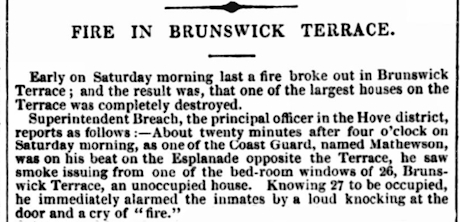
Brighton Gazette of 9 September 1852
Nine years later in the main house there is a new family who had come all the way from Scotland. Adam Hay and family brought most of their servants from Scotland too. With the family in the main house were Thomas Thomson, a 33-year-old coachman originally from Midlothian and Cuthbert Paterson, a 19-year-old groom from Scotland. The 1861 census doesn’t record anyone in the stable block so it’s not clear why the staff were living in the main house. It’s also not clear whether the Hay family’s horses and carriage had travelled all the way from Scotland or whether they were planning to use local facilities while they were here. If there were horses in the stable block, they weren’t, unfortunately, counted in the 1861 census.
Ten years later the 1871 census finds Thomas Buckwell, a porter, and his wife on their own in the main house, presumably looking after it for the owner. There is nobody in the stable either.
People come and go to the main house over the following decade but both the house and stable appear to be unoccupied in 1881. By 1883, however, a coachman by the name of J Peel is in the stable and he’s running a side-business selling dogs.

Southern Weekly News of 17 March 1883
The stable story gets more confusing in 1891 when Persis Rooke, a 73-year-old widow with all her family and servant staff from Hampshire, is living in the main house. Also in the main house are Benjamin Read a 39-year-old married domestic coachman and 20-year-old Alfred Hewitt, the groom. Meanwhile, in our stable is Edward Cordery, a domestic coachman with his wife, Ann, and daughter, Rosina. The other stables in this row of buildings backing onto Brunswick Terrace also have domestic coachmen in but it seems that Edward Cordery would not have been employed by the current occupants of 27 Brunswick Terrace as the owners had their own staff from Hampshire.
Edward Cordery was born in Richmond, Surrey about 1839 to a father who was a farm labourer. By the time he was 12, with his father no longer around, Edward was employed as a groom in Richmond helping support his mother who was earning a small amount of money as a laundress. Edward would spend at least 50 years of his life working with horses either as a coachman or a groom. Employment by a wealthy family in Hove would have been a step up from his father’s life as a farm labourer.
Later Edward, now married to Ann and with a daughter and son, found more work as a groom in Chertsey, Surrey, before finding employment in Hove by the 1880s. In 1881, he’s living at 4 Adelaide Mews, off Hove Street, and has moved up to being a domestic coachman. A domestic coachman reported directly to his employer and, being in command of the stables, the most important building after the house, was responsible for caring for and providing all the master's horses and carriages and related employees. This was a big step up from his previous role as a groom.
In 1901, our stables at 27 Brunswick Street West are unoccupied again and Edward and family have had to find accommodation elsewhere. They clearly found the local area to their liking and Edward was still a domestic coachman in 1901 when he was living in 22 Farm Road along with his wife and daughter and 11 other residents! The building is three stories high so there were plenty of rooms and there would have been stables at the back. Whether Edward worked here as well isn’t known. At the age of 72 in 1911 he describes his profession as coachman (past work) so, he’s presumably finally retired.
The main house in Brunswick Terrace is owned by William Brass, a building contractor and property owner, from 1901 to 1913 and there are no stable staff living in the house with him. The Brighton Gazette of Thursday 14 February 1901 reports William Brass having an accident while riding a newly purchased horse along Palmeira Mews (now St John's Road) so his stables were probaby there. Our stable appears to be empty in 1901 but by 1902 another crime is reported there:
Hove Bench: Before Alderman Henriques (in the Chair) and Mr D. C. Thomas
"A very mean theft" was the Chairman's comment with reference to the stealing of 6d by George Martin, of 118, Conway Street, Hove, the money belonging to Edward Hawes, of 27, Brunswick Street, Hove.
Prosecutor told the Magistrates that on several occasions he had missed money from his bedroom, and he eventually spoke to Detective-Sergeant Parsons, who came on Thursday evening and marked several silver coins. On Friday morning he concealed himself in the bedroom, when he saw prisoner come in and open the drawer where his (prosecutor's) money was kept. After prisoner had left, witness went out and informed Detective-Sergeant Parsons, who was waiting. Prisoner had no right to go to his bedroom, his business simply being in the stables.
Sergeant Parsons bore out this statement, and said he instructed the prosecutor to watch. About noon on the Wednesday prosecutor came to him and said prisoner had taken sixpence from his bedroom. The detective followed prisoner to Palmeira Mews, where he asked him how much money he had. He replied that he had none. The officer searched his pockets but found nothing, and he then found the money in prisoner's right hand. When charged prisoner made no reply, and was taken to the police station. Prisoner was sentenced to fourteen days' hard labour.
We’re left wondering what Edward Hawes was doing in the stable but it seems likely that the prisoner, George Martin, was the groom or stable lad and Edward was merely renting the accommodation above. Had Edward been the coachman, he would have had the authority to terminate the groom’s employment and the newspaper article would have mentioned that.
In 1911 there is, surprisingly, a coachman, Frederick Taylor, in the stable who gives his occupation as domestic coachman and he’s living with his son, also Frederick, who’s a stable keeper. They are both employed by someone but it seems likely that it’s not the owner of the main house.
William Brass, the owner of 27 Brunswick Terrace, dies in 1913 and the property is put up for sale.
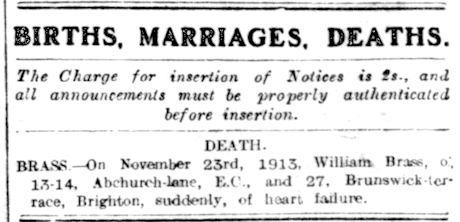
Brighton Gazette of 26 November 1913
There is no mention of the stables on the sales particulars so it’s possible that they had been sold off some years before.
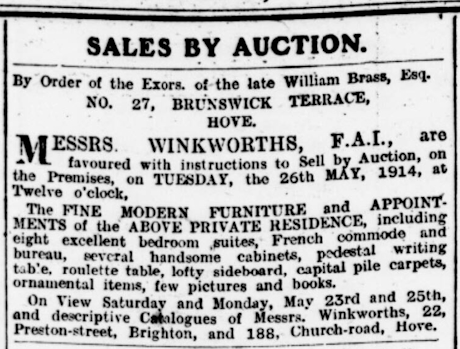
Brighton Gazette, 16 May 1914 – sale of 27 Brunswick Terrace
By 1921 the main house is occupied by Henry Holman Greenwood and there are no coachmen or grooms in the main house. In our stable block is Harry Brakes, a salesman for Lyons & Co, a local tea shop and supplier. Harry is based in Middle Street, Brighton.
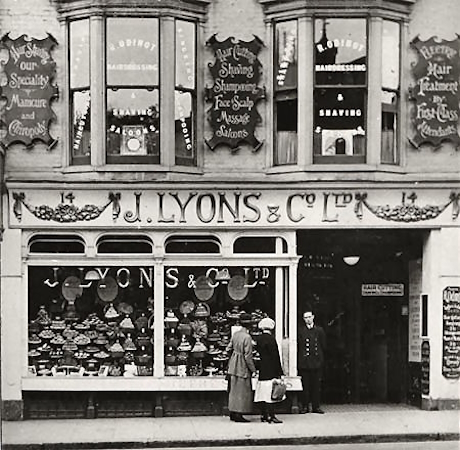
One of the Lyon’s Tea Rooms in North Street, Brighton about 1950
At the age of 21, Harry was a butcher’s assistant to George Henry Glasbey in Rotherham but by 1921 he’d moved to Hove in search of better work. He stayed in Brunswick Street West with his wife, Hilda, until 1924 by which time they’d moved to Church Street.
Lyons had four tea rooms around Brighton and the Middle Street location appears to be a warehouse. Originally known as the Brighton Bakery until 1929, it produced goods for the teashops in the area. Products included Iced Fancies and Battenburg cake!
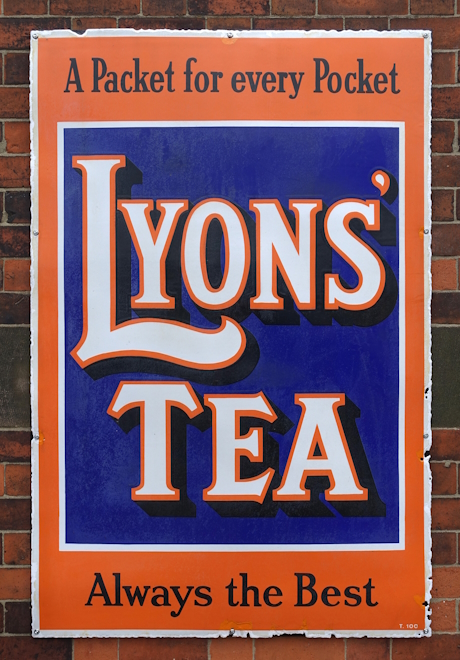
The era of horse-drawn transport was coming to an end and I wonder if Harry would have had a motor vehicle to conduct his sales business.
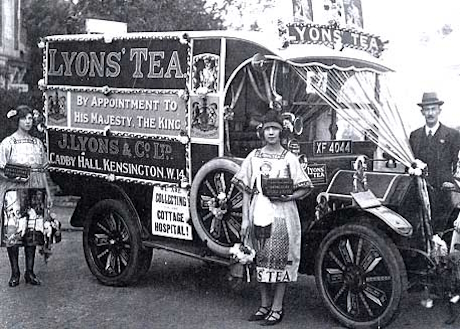
A Lyon’s Tea van based in London
By the start of the second world war Harry described his occupation as a general labourer living at Centurion Road, Brighton. He was only 50-years-old so he probably saw service in the war.
Meanwhile, with the stables no longer being used by horses and carriages, in 1930 our stable block, now numbered 9 Brunswick Street West is being altered for residential accommodation and the ground floor is having a garage installed.
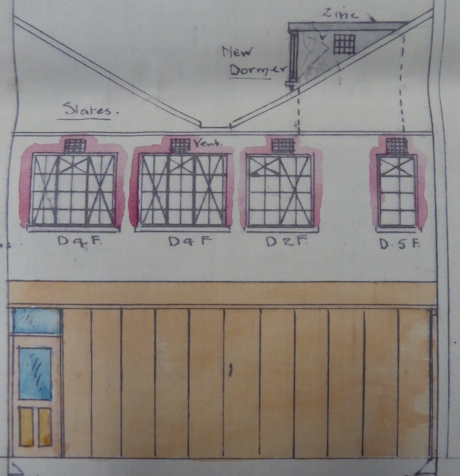
1930s Conversion from Stable to Garage with accommodation above. Source: The Keep
The garage would later be removed to make a larger family home.
Research by Kevin Wilsher, 2026
Return to Brunswick Street West page.