Sign up for our Newsletter
Our monthly newsletter lists our upcoming events, reviews, news from the Town House, history features and snippets, plus a local exhibition listing.
Contact Us
The Regency Town House
13 Brunswick Square
Brighton & Hove
East Sussex
BN3 1EH, UK
17 Brunswick Square
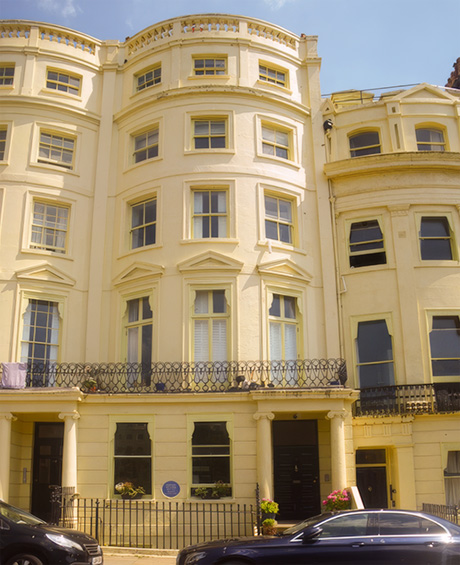
Number 17 Brunswick Square sits nearly at the top of the square on the eastern side. The plot was first purchased off plan by a speculator, Charles Elliot, who also purchased numbers 16 and 19. He employed builder George William Sawyer to construct the houses for £3000 (around £386,000 today), “to be finished complete, prepared, painted with all drains, stores and pavements, the fixtures to be set at Mr Sawyer’s expense”.
There is no record of when the house was completed or who then purchased it, but we do know it was occupied by 1832. As was customary for the big houses it was let for the season, and number 17 had visits from Mr Daly MP, the Earl and Countess of Newbury, Lord Dalzell and the Countess of Carnworth.
The first family known to own and live in the house were the Polhills. Edward Polhill Esq and Anne Graham were married in 1823. Both families had properties on Clapham Common, London. Edward is described as a lawyer, landowner, Gentleman and mortgagee in the Census documents. He attended Trinity College, Cambridge and studied the law as an apprentice in Lincoln’s Inn. His father, Edward, was also a lawyer, and his mother, Sarah Ward Polhill, was the daughter of John Spooner, who at one time was the President of the Council of Barbados. Anne’s parents were Thomas Graham, a lawyer, whose family home was Edmond Castle, Hayton in Cumbria, and Elizabeth Graham.
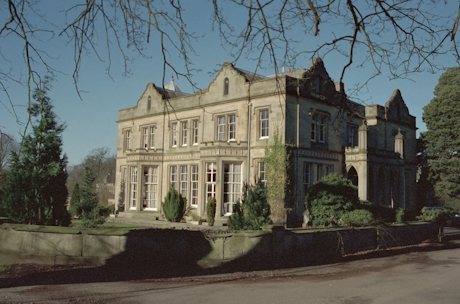
Edmond Castle, Hayton
Elizabeth was an author of children’s books and “Eighteen Maxims of Neatness and Order”, giving “advice on creating a more orderly and efficient home”. Elizabeth wrote this book under the pseudonym of Theresa Tidy. It proved very popular and had at least 10 editions.
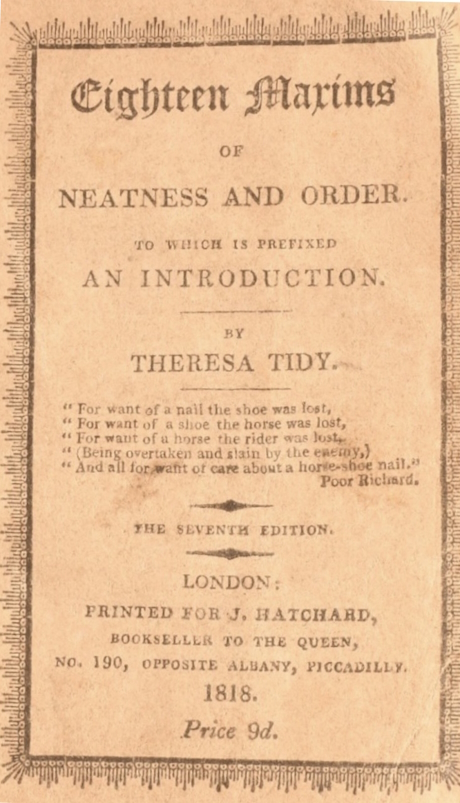
The cover of Elizabeth’s book
Following their marriage, the Polhills lived in France for a time where they could live more economically. The New York Public Library archives have a collection of some amusing sketches drawn by Anne while they were living in France, showing quite a wry sense of humour.
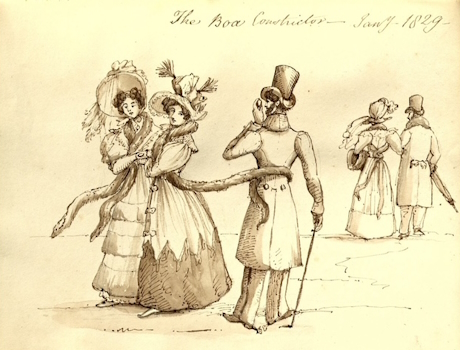
Sketch by Anne Polhill. Credit The New York Public Library Thanks to Dr Liz Dellinger, Curator.
It is not known when the Polhills moved into number 17. The first record of them living there is in 1836 when Edward became a Brunswick Commissioner, a post he held until his death. However, in a letter to her mother in 1834 Anne talks of employing a nanny and the difficulties in finding a good cook in Brighton, so perhaps they had taken up residence at number 17 by then. By 1834 they had 4 children. Emily, baptised in Marylebone, London; Arthur and Robert who were baptised at the same time in 1829 in Heckfield, Hampshire; it is possible the boys had been born in France and baptised on their return to England; and Laura who was baptised in St Nicholas’ Church, Brighton. Their youngest Charles, born while they were living at number 17, was baptised at St Andrew’s, Hove.
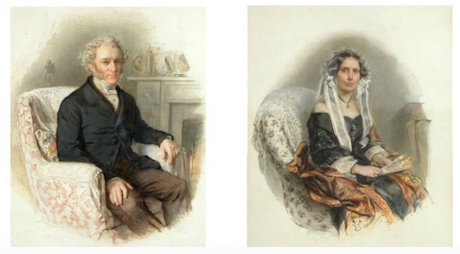
Edward and Anne Polhill (artist unknown)
While living in Brighton both Edward and Anne were involved in many worthy causes. Edward was on the board of the Society for Improving the Dwellings of the Industrial Classes, the Society for the Propagation of the Gospel in Foreign Parts, Committee of the Church of England Scripture Readers, and Anne on the Brighton Lying-in Institute, Lancashire Distress Fund and the Gentlewoman’s Aid Society. Edward was also a Governor of the Sussex County Hospital and in 1847 sat on the council of the newly planned Brighton College, although there is no record of him continuing his association once the school opened.
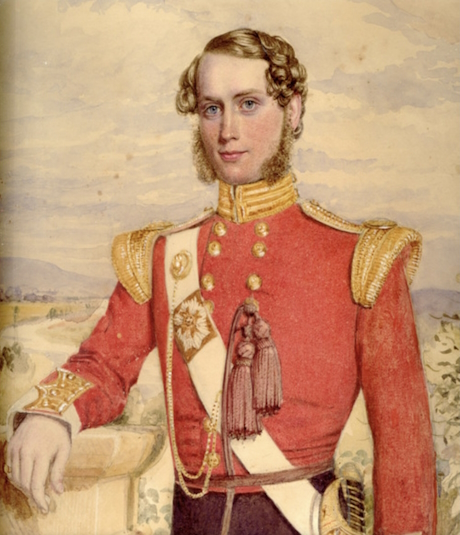
Lieutenant Polhill of the 95th
Robert, Edward and Anne’s second son, joined the 95th (Derbyshire) Regiment of Foot and was promoted to Lieutenant in 1852. The first major military engagement of the Crimean War was the Battle of Alma in 1854 and the 95th was part of the English attack. Robert was killed by a musket ball in the head still holding his sword, “he fell, as a brave soldier could wish to fall, between the foe and his sovereign’s flag” (Our Heroes of the Crimea 1855). Robert was buried in All Saints Church, Renhold, Bedfordshire.
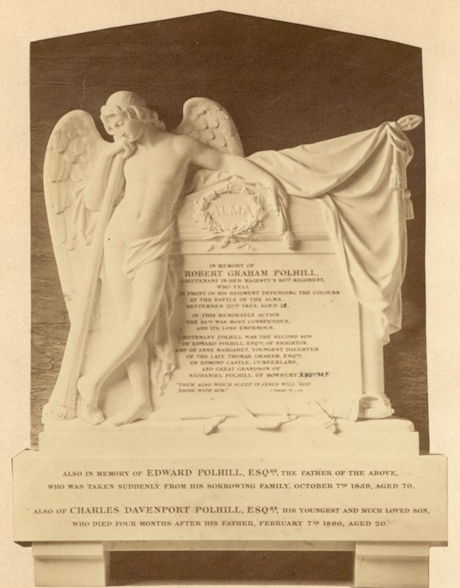
Robert Polhill’s memorial
Edward died suddenly in October 1859 aged 70, while visiting his nephew’s house in Eastbourne. His obituary below, from the Brighton Gazette records how well respected he was and writes of great generosity with both his time and money. He was buried at Ocklynge Cemetery in Eastbourne.
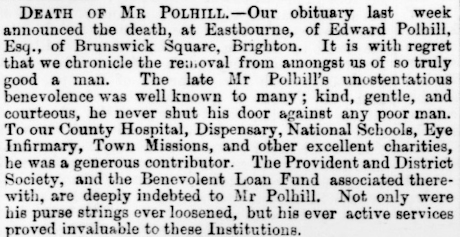
Death of Edward Polhill, Brighton Gazette 27 October 1859
Sadly, Edward and Anne’s youngest son Charles died at Brunswick Square only a few months later in February 1860, aged 20. He was buried alongside his father in Eastbourne. Following their deaths both Edward’s and Charles’ names were added to Robert’s memorial in Renhold.
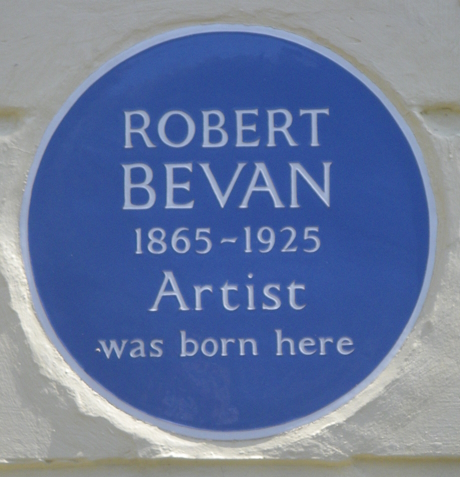
Blue plaque at number 17
In 1861 Laura, the Polhill’s second daughter married Richard Bevan. Richard was a partner at the Union Bank in Brighton which later became part of Barclay & Co. Richard and 3 of his brothers were appointed Directors of Barclay & Co, based at the headquarters on North Street, which is still occupied by Barclays Bank today. In August 1865 the Bevan family were staying at number 17 while their new house in Cuckfield was under construction. During their stay Laura gave birth to their fourth child, Robert Polhill Bevan.
Robert decided not to follow his father into banking and following school spent time studying painting in Paris and then travelling in France, Spain and Tangiers. On his return to England, he lived on Exmoor spending the time hunting and painting the agricultural landscapes and hunting scenes. In 1897 he married the Polish painter Stanislawa de Karlowska in Warsaw. Robert has been called the “real pioneer” of the modern English School, although he did not sell any paintings in his own lifetime.
More information on Robert Bevan can be found on the Tate Britain website. The Regency Town House website also has a collection of several letters from the Bevan and Dewar families donated by a descendant of the family, they can be read here.
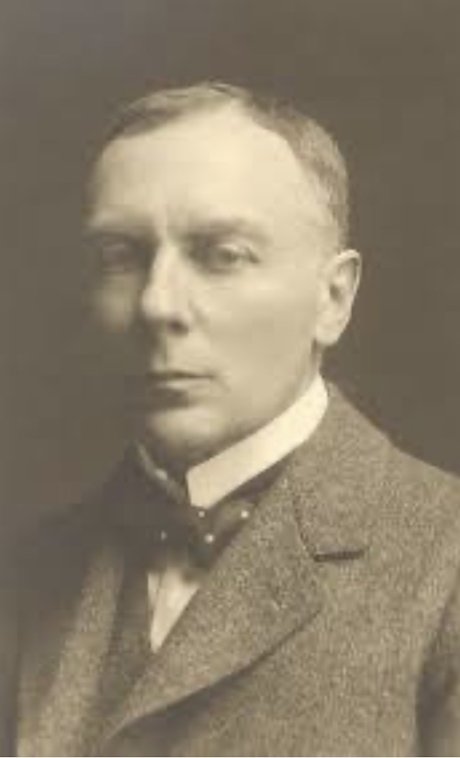
Robert Bevan
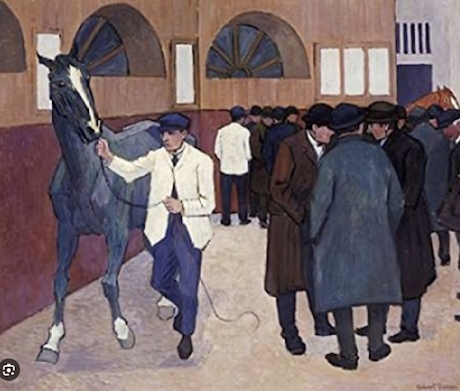
Horse Dealers by Robert Bevan
Following the death of Edward, Anne continued to live at number 17 with her eldest daughter Emily and son Arthur, both unmarried. By the 1871 census she had been joined by Jane Gathercole who was listed as a lady’s companion from Hayton in Cumbria, the village of Anne’s childhood home. Jane lived with the family until her death in 1884. Her obituary reads “Mrs Jane Gathercole, for 39 years the much-loved friend and assistant of Mr Polhill’s family.”
In 1879 Arthur died at number 17, aged 53. Anne lived for another 2 years before also dying, at home, at the age of 81 in 1882. Emily continued to live on the Square, but the 1891 census shows that she had reduced the number of staff from 8 to 4 perhaps reflecting her retirement years. She died in 1898 at the age of 73. Anne, Arthur and Emily were all buried alongside Edward and Charles in Eastbourne. Emily’s estate on her death would have been valued at £4.5 million today.
It is very difficult to trace the many people who would have lived and worked as servants in the large houses in Brunswick Square. Number 17 had up to 8 servants at a time including cooks, maids, lady’s maids, a footman and at one time John Harrison, aged 14, from Carlisle, who worked as a page in the 1880s. Annie Palmer was a lady’s maid, first mentioned in the 1861 census. She was from Hayton so perhaps Anne knew her family, the Polhills had employed several servants from Hayton or Carlisle over the years. Annie Palmer stayed with the family until Emily’s death; she would have been around 66 years old. In the 1901 census she was living in West Hill Street, Brighton with her nephew. The census records her as “living on her own means”, so maybe Emily had left her a bequest in her will.
As we enter the 20th century the next family known to have lived in the house are the Charletons. By 1900 Charles Charleton Esq, from London, and his wife Marie Sophie Lebrun from Le Havre, had moved into number 17 with their daughter Mary, aged 26, and son Edward, aged 24. Charles and Marie had married in St Pauls, Knightsbridge in 1873. The Keep has building plans showing alterations to the house made around 1900, adding bathrooms to the ground and first floor. At the time the front room on the ground floor was being used as a Billiard room.
The 1871 census records Charles as a 19-year-old student in Newcastle upon Tyne studying Analytical Chemistry. Following his studies it is likely he joined I C Johnson & Co Ltd in Gateshead. His father, Edward, was working in the manufacturing of cement and had joined a partnership with I C Johnson and other cement manufacturers to operate a plant in Gateshead. In 1883 Charles was appointed Partner and Sales Manager for I C Johnson and in 1911 became Vice-Chairman of British Portland Cement Manufacturers Ltd which, along with other manufacturers, later became the Blue Circle Group.
It seems that while living on the square Charles and Marie enjoyed the social life in Brighton. They are mentioned many times in the society pages attending the balls and events of the season. The papers particularly liked to describe Maria’s dresses in detail. At one ball in 1912 they note, “Mrs Charleton looking notably nice in moonlight sequinned net, over which satin and touches of lace with pearls and diamond ornament proved a delightful finish.”; and at a wedding in 1910, “Mrs Charleton was gowned in handsome black satin, the corsage adorned with fine silk passementerie and touches of jet. Her black Parisian chapeau was mounted with panache of ostrich feathers, and tulle, and she also wore an ostrich feather boa as finish.”
In June 1905 the couple’s son Edward married Maud Turner of Denmark Terrace, in St Patrick’s Church, Hove. Edward had followed his father into the cement business and was appointed a director in 1911 when British Portland Cement was formed. The couple had three children, Joan, Edward and John. Maud died in 1936 and Edward remarried in 1942 to Margery Mitchell. In 1951 Edward died at his home in Dyke Close, Hove, leaving an estate of £36,188 (£1.47 million today).
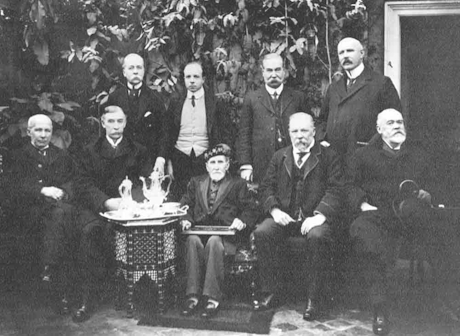
Edward Charleton (2nd from left back row) and other Directors British Portland Cement
In 1906 Charles and Marie’s daughter, Mary, married Edgar Hester. Edgar was born in Brighton and lived in Westbourne Villas, Hove. In 1907 he joined the Royal Inniskilling Fusiliers as a career soldier. He was seconded to the West African Regiment serving in Sierra Leone and was promoted to Lieutenant in 1910. While he was serving overseas Mary probably lived at number 17 with her parents.
Before the start of the First World War Edgar returned to the Fusiliers and was promoted to Captain. He was listed as missing during the fighting in Belgium in August 1917, but it was not until 1919 that he was officially declared dead and buried in the Bedford House Cemetery at Ypres. He has a memorial plaque in St Andrew’s Church and a very fine stone memorial in St Margaret’s Church, Oxford probably erected by his grandfather George Parsons Hester who was Town Clerk of Oxford at the time.
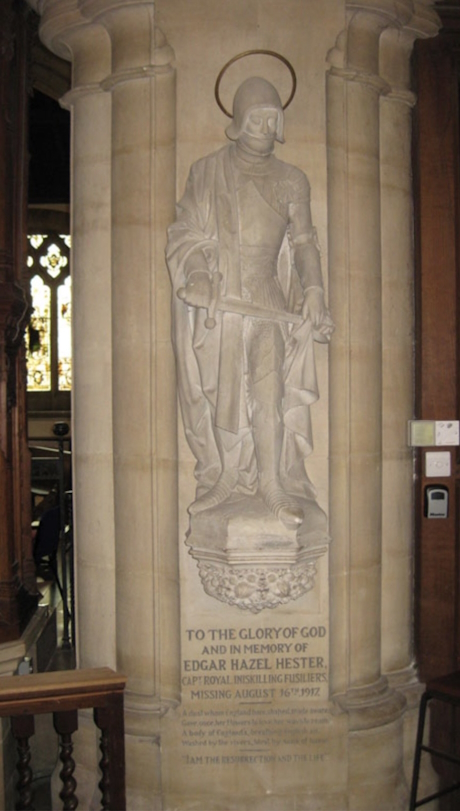
Edgar Hester’s memorial in St Margaret’s Church, Oxford
Charles died in December 1916, leaving Marie an estate of £32,855 (worth £3.7 million today). Marie stayed on at number 17 until her death in 1918.
After her parents' deaths Mary moved to Earl’s Court and in 1934 joined the Women’s Reserve police force. By the 1939 census she had returned to Hove, living in Hove Park Way with friends, Minne Tangas and Elizabeth Buckwell, and their maid servant. On her death in 1960 she was living in Holland Road. Her effects came to £46,965 (£1.4 million today) which she left to her two companions.
In 1919 the new family that made number 17 their home was Alfred Heathcote Copeman MA MD, his wife Eva, daughters Margaret (aged 18), Angela (aged 17), and sons Nicholas (aged 13) and Michael (aged 11). The family lived in Brunswick Square until 1927, when they then moved to a house called Highdown on Dyke Road Avenue.
Alfred was born in Catfield, a small village in Norfolk. His father, Arthur, was the Vicar at St Andrew’s in Norwich, although he had completed a Bachelor of Medicine. Alfred was an undergraduate at Sussex College, Cambridge and then went on to study medicine at Trinity College, Dublin and St Thomas’ in London. He was first registered as a surgeon and physician in 1894. There are records of him practicing in London, Cowes on the Isle of Wight and finally Brighton. He published 4 medical papers, interestingly one on “Sea Bathing” while living and practicing in Pavilion Parade in Brighton 1911. By 1938 the Medical Directory shows him as retired.
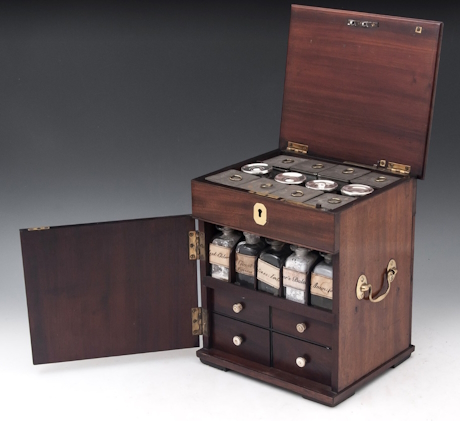
A Duke of York Medicine Chest once belonging to Arthur and then Alfred.
Alfred and Eva had married in 1899 at Christ’s Church, Lancaster Gate, London. The society pages reported that they were married by the Reverend A Garry Copeman, the bridegroom’s brother. They had 6 bridesmaids, a reception of 400 guests and honeymooned in Switzerland. Eva’s parents were Sir Walter Wilkin and Lady Margot Wilkin. Sir Walter qualified as a barrister, but on the death of his father and brother he took over the running of the family’s business in the City as yeast importers. He also served as Lord Mayor of London in 1894/95.
Following their marriage Alfred and Eva lived on the Isle of Wight, where Alfred had an established practice. Their first 2 children, Margaret and Angela were born on the island but by 1904 they had probably moved to Brighton. They are mentioned several times in the local papers attending the various social events in the town. In 1907 Alfred was appointed Surgeon Lieutenant of the 1st Volunteer Battalion, the Royal Sussex Regiment. The couple made several overseas trips, their names appear on ship’s passenger lists travelling to Algiers, Casablanca and New York, first class of course.
In 1918 Eva appeared on the electoral register alongside Alfred. After decades of campaigning the 1918 Representation of the People Act gave the vote to all men, but more significantly, for the first time women over 30 were able to vote in parliamentary elections, provided they met certain qualifications. As Eva was married to a man on the local government register, she was entitled to vote, but 60% of women still did not qualify.
The couple’s eldest daughter, Margaret, married Captain Horace Armstrong Goldsmith at St Margaret’s Church Brighton in 1921. He was a career soldier joining up in 1905, he had served in Burma and then transferred to the 95th Infantry of the Indian army. In 1916 he was awarded the Military Cross for his services during the war. Their son, David, was born in Baghdad, in 1922. At the time Horace was serving as a diplomat in the Iraq Political Department. Sadly, David had a very short life, dying aged only 9. In January 1924 Margaret and David had returned to Brunswick Square from Bombay, now Mumbai. In June of that year Horace was also on his way home from Bombay when he caught meningitis and tragically died at sea. The following obituary from the Yorkshire Post June 1924 tells a story of a brave man who had led a very adventurous life.
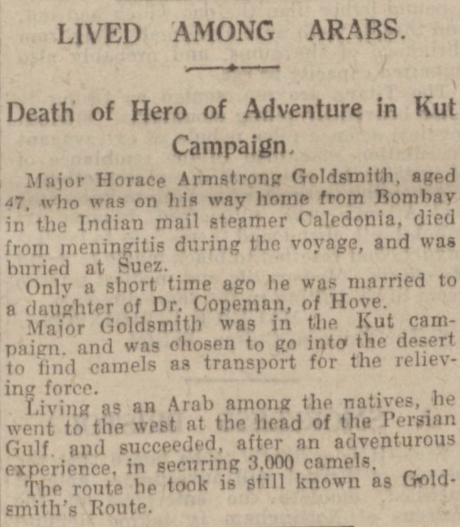
Horace Armstrong Goldsmith's obituary, Yorkshire Post June 1924
Margaret married a second time to Group Captain Harry Redvers McLaren-Reid DFC, in 1927. Harry had begun his career in the Airforce in 1918. The RAF was established in April 1918, it was the world's first independent air force, detached from the army or naval control. He led a very distinguished career and was awarded the DFC in 1924. Following their marriage the couple spent the next 20 years on postings in the Middle East, India and South America, experiencing life in the diplomatic service in the RAF during the interwar years. By his retirement in 1948 Harry had been promoted to Military Liaison Officer.
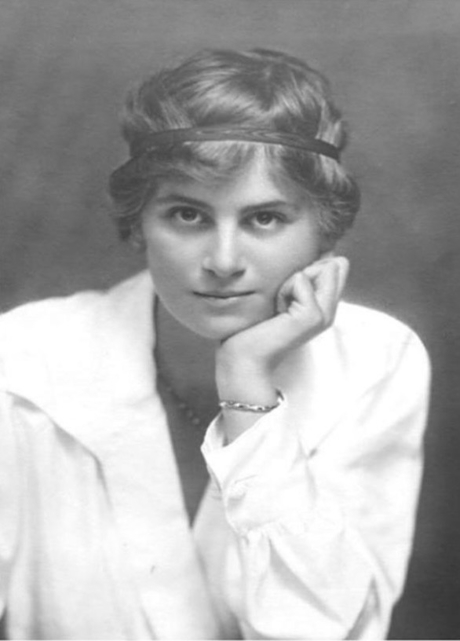
Margaret McLaren-Reid. Copyright Envelope Books
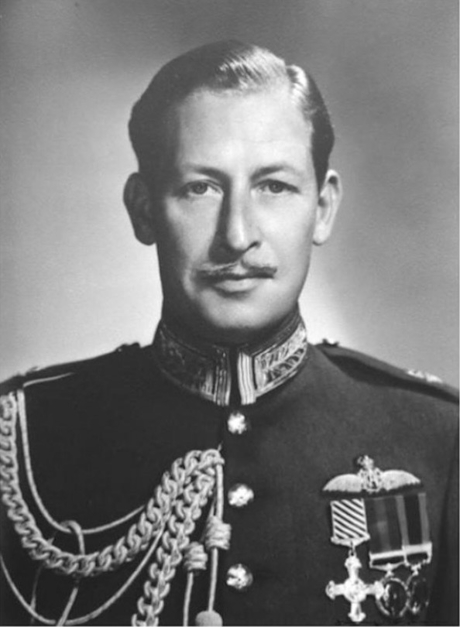
Harry McLaren-Reid DFC. Copyright Envelope Books
The couple’s only child, Harry Alastair McLaren-Reid, was born in 1929. It has been difficult to find any information on Alastair but it is possible he followed his father into the forces as there is a mention of a Major Alastair McLaren Reid in 1967.
Alfred and Eva’s second daughter Angela was born in Cowes in 1902 and moved with her parents to Dyke Road Avenue, when they left Brunswick Square in 1927. She married Maurice Whittome, in 1934 in Brighton. Maurice was a solicitor and in 1955 was Knighted for his work on the Board of Customs and Excise. The couple’s son, John was born in 1933. They lived in Surrey for several years before moving to a farm near Haywards Heath. By the time of her death in 1986 Angela was a well-known breeder of Guernsey cattle.
Alfred and Eva’s eldest son Nicholas also had a very distinguished military career, this time in the Navy. He served in Norway during the Second World War for which he was awarded the Distinguished Service Cross. By the time he retired in 1963 he was Commander-in-Chief, South Atlantic and South America Station, based in Freetown, Sierra Leone. Nicholas married Violet King in 1933. The wedding was described in the following article from the Naval and Military Record.
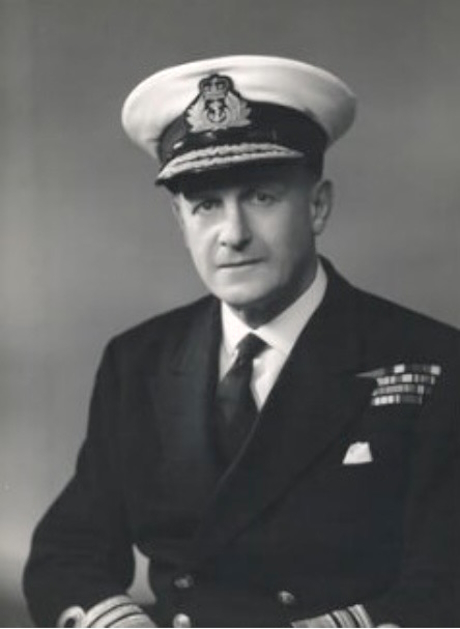
Commander-in-Chief Nicholas Copeman DSC
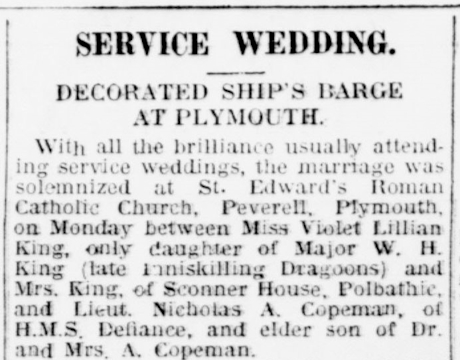
Marriage Naval & Military Record and Royal Dockyards Gazette, Thursday, 7 December 1933
The article on Nicolas’ wedding mentions his younger brother Michael. Michael was born in Brighton in 1908. He also married his fiancé, Barbara Odling, in 1933 in Brighton. Barbara’s family ran Anselm Odling and Sons a marble and granite merchants established in 1870. Following their marriage Michael was appointed a director of the company. In 1940 he joined the army as a Captain in the Royal Ordnance Corps. Unfortunately, as with many, he died on active service, following an operation in a military hospital in Yorkshire, in 1942. Michael had been educated at Charterhouse School from 1921 to 1926 and the photograph below is taken from their Roll of Honour Memorial Archive.
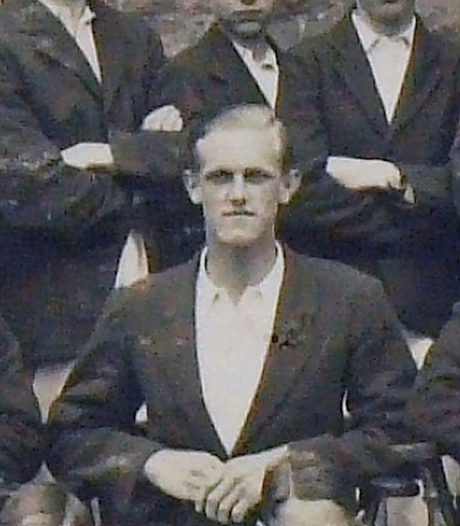
Captain Michael Copeman
The next residents to move into number 17 were the Sherriff family in 1928, staying for 3 years before moving on to Shirley Drive in 1931. The head of the family, Walter, was recorded on the 1921 census as a “Merchant of coal and corn, miller and farmer” working as a Director of Sheriff and Sons Co Ltd. The company was set up by his father at Lemsford Mill near Hatfield in the 1870s. The company remained in the Sherriff family until the 1980s.
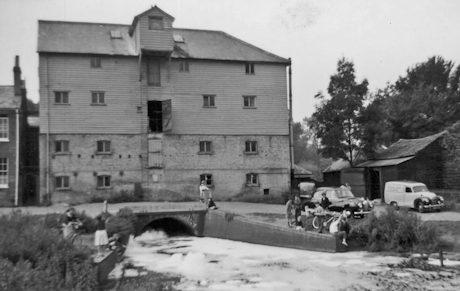
Lemsford Mill, Hatfield
Walter had married Sarah Martin in Hatfield in 1902 and lived in Hertfordshire before taking up residence at number 17. They moved in with their children Kathleen (aged 24), Violet (aged 21) and Enid (aged 14). Kathleen married Rudolf Boubelik, born in Vienna, in 1930. Under the British Nationality and Status of Aliens Act 1914 Kathleen lost her British subject status as she had married an Austrian. This resulted in both Kathleen and Rudolf being interned as Enemy Aliens at the start of Second World War. They were later released and exempted from all restrictions, and Kathleen was able to re-naturalise in January 1941. The couple lived on a small holding near Burgess Hill.
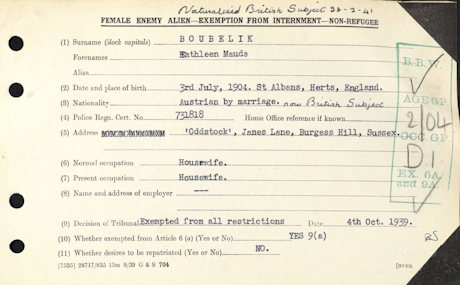
Kathleen Maude exemption from internment
Following the Sherriff family’s stay at number 17 it is difficult to trace any residents. A Miss E Wilkin lived there for 2 years and then in 1936 the property is given the title of “Brunswick Chambers”, so has probably been converted into a boarding house. By 1940 the house is described as “flatlets”, which were run by a Mrs Bush and her relatives until 1973. In the Sussex Daily classifieds in 1953, Mrs Bush placed several adverts for “Flatlets; newly furnished; decorated; entirely self-contained, grill, heating and lighting; basin; serviced daily” and was also seeking someone to help with cleaning in the house. Today the house is home to 8 flats over its 6 storeys.
Research by Joanne Smith, September 2026
Return to Brunswick Square page