Sign up for our Newsletter
Our monthly newsletter lists our upcoming events, reviews, news from the Town House, history features and snippets, plus a local exhibition listing.
Contact Us
The Regency Town House
13 Brunswick Square
Brighton & Hove
East Sussex
BN3 1EH, UK
Stable appeal - Further detail
Return to Introduction (and how to make a donation)
Our concern to preserve cultural legacy is deep-rooted and ancient, but our concept of the ‘build heritage’ owes much to the work of individuals, voluntary groups and largely anonymous state actors over the last 150 years. Through this timeframe the safeguarding of the historic environment has greatly improved, but we still sometimes leave important sites vulnerable.
A compelling example of this relates to England’s traditional farmsteads. Long recognised as seminal to our countryside, only in the last 20 years have they been mapped and researched in detail, their contribution officially acknowledged. No such activity has occurred regarding urban equestrian architecture. This malaise has arisen for two key reasons:
-
In the early 20th C, before listing was introduced, the stabling attached to large town houses was generally sold off. Connecting doorways were bricked up, back streets were renumbered, and new property titles issued. These steps broke the link between the front and rear quarters of such buildings and saw the latter omitted from lists.
- After WW2, as listing was implemented, it was widely held that the working areas of historic properties were unimportant, with protection unnecessary.
Because of these factors, today our city has a little over three thousand listed residential properties but only a handful of related equestrian locations. Moreover, where examples do survive, they generally have little original character externally and none internally.
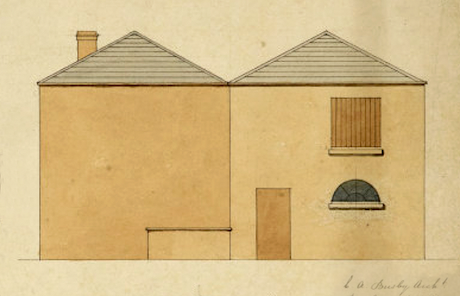
C A Busby drawing of front elevation for a Brighton stable, 1828
Yet, urban stabling, especially within once fashionable locations, is of significant heritage value. Purpose designed to be functional, hygienic, comfortable for valuable animals, and secure for expensive coaches, such sites provide tangible links to now largely forgotten practices and illuminate the experiences of the highest-born residents and lowliest of working staff - showcasing key aspects of social, economic, technical and architectural history.
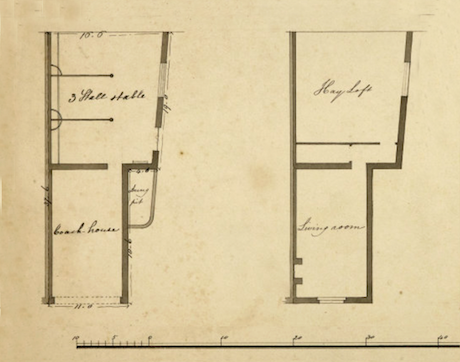
C A Busby plan for a Brighton stable, 1828
At The Regency Town House, we recognise that the stabling around us formed a crucial element of a meticulously designed landscape, and that it constitutes the second most important component of the estate. Each stable was a hub of activity, indispensable to the operation of a grand home - the very driving force behind daily life. While, collectively, such stabling provided the backbone to our success as a ‘resort destination’.
Securing, repairing and preserving the important stable complex behind No. 13, with its stalls for animals, coach stand, tack room, and staff quartering, will enrich local heritage provision and aid a nuanced understanding of how our grand house and great seaside estate once operated.
Please support our endeavour to save a rare piece of local heritage and tell an important national story:
If you're an individual and would like The Brunswick Town Charitable Trust (Reg. UK. No. 1012216) to benefit from Gift Aid you can use our secure page hosted by Charities Aid Foundation, MAKE A DONATION via CAF Bank
Alternatively, making sure you provide us with your email address, so that we can send you a Gift Aid form, use one of the methods below.
Post a cheque (payable to, The Brunswick Town Charitable Trust) to:
The Regency Town House (stable appeal)
13 Brunswick Square
Brighton & Hove
BN3 1EH, UK
Make a donation by bank transfer using the following details:
Account Name: The Brunswick Town Charitable Trust
Account number: 66904617
Sort code: 60-30-09
Payment reference 'stable appeal'
(please also ensure you provide your email address)
Please note, if you make a donation made via a corporate or business card/account we cannot claim Gift Aid. If you are offering support as a commercial organisation, please either post a cheque or use bank transfer.
If our campaign is unsuccessful, we will return donations or, with your permission, use funds for the maintenance of The Regency Town House.