Sign up for our Newsletter
Our monthly newsletter lists our upcoming events, reviews, news from the Town House, history features and snippets, plus a local exhibition listing.
Contact Us
The Regency Town House
13 Brunswick Square
Brighton & Hove
East Sussex
BN3 1EH, UK
Brunswick Town Painting
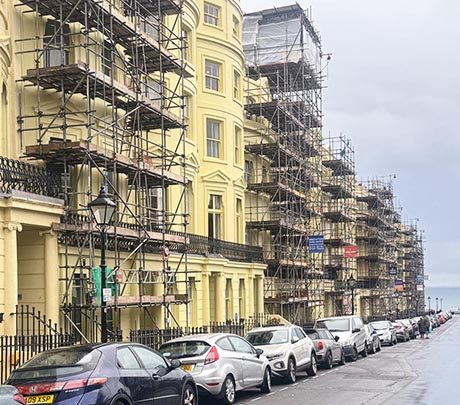
Brunswick Square in 2026
You may have noticed that every few years, Brunswick Square and Terraces are covered in scaffolding. You may also have wondered why this happens and who pays for all the work. To answer those questions, some history is called for.
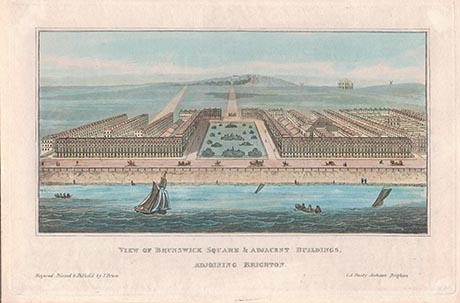
C.A. Busby’s plan for Brunswick Town, 1828
Charles Augustin Busby’s development of Brunswick Town from 1824 produced a large community located just over the Brighton border into Hove Parish. As late as 1836, Hove village was described as a ‘mean and insignificant assemblage of huts’ and Hove Parish did not have the capability to manage a development as large as Brunswick Town. As it lay outside of the jurisdiction of Brighton, a special Act of Parliament was required to create a separate authority for its management.
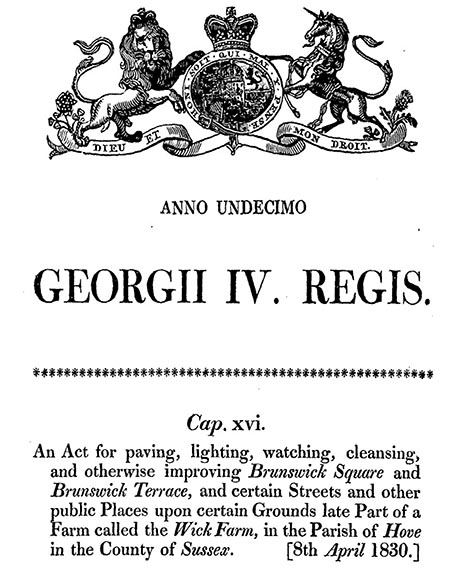
In April 1830, the Brunswick Square and Brunswick Terrace Improvement Act 1830 was enacted giving rise to the Commissioners for repairing, lighting, watering, and watching Brunswick Square and Terrace, and the Squares and Streets adjacent. Amongst many other stipulations, the act mandated that every three years the occupiers must paint the outside woodwork and ironwork of each house at their expense. It also mandated that:
the present Front Elevations of the said several Houses shall at all Times hereafter be in all things maintained unaltered, and without Variation, and the Fronts of the same Houses, and the Chimney Shafts thereof respectively, be and remain covered with Parker's or Roman Cement, of one uniform Stone Colour
Preserving the uniformity of the estate was the key aim of the legislation, although there was no mention of painting the facades.
It’s not clear when painting of the houses’ facades was first adopted but in 1847, a ‘painting year’, there is a newspaper report of a painter having an accident.

Brighton Gazette, 24 June 1847
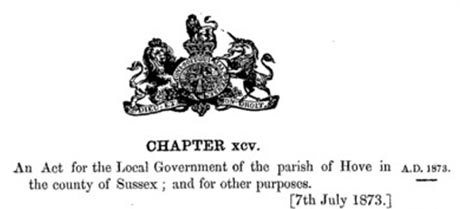
The Hove Commissioners Act 1873 unified local administration across the parish of Hove replacing the Brunswick Square Commissioners and amalgamating with the West Hove Improvement Commissioners into a single, Hove-wide board of 64 town commissioners. The new act incorporated the provisions of the 1830 act with no changes to the painting requirements.
The painting seems to have continued regularly every three years until 1916. During the Great War there was a debate about whether the requirement should be suspended as an economy measure. Hove Town Council decided that, as the painting requirement was an act of parliament, they had no authority to suspend the painting so it should continue as normal.
Despite John Piper’s rather psychedelic image of Brunswick Place, the buildings would have been painted the same cream or stone colour.
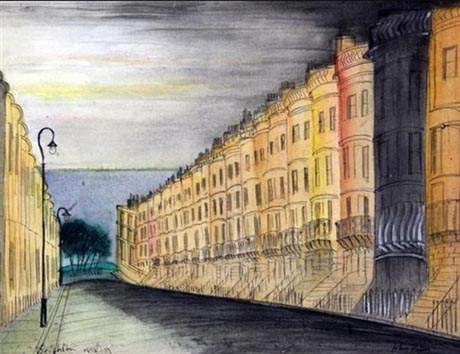
John Piper: Brunswick Place (recorded as Brighton Street), 1939
Painting was suspended in 1943 during the second world war.
In 1974 Hove Council issued the usual instructions to the residents to start the three-yearly painting but did allow some variety of colour (either light or dark oak) for the doors.
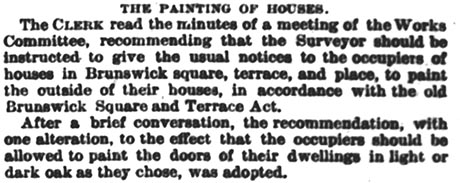
Sussex Daily News, 20 March 1974
During the late 1960s and ‘70s, not all of the owners of properties in the area were interested in preserving the historical uniformity of the houses – especially if it was going to cost them money. In 1967 and 1970 one of the residents refused to repaint the house and, possibly for the first time in 140 years, read the 1830 act. They discovered that, whilst the act mandated painting the woodwork and ironwork, there was no mention of painting the houses themselves.
To remedy the situation another act of parliament was needed. The 1976 Hove Borough Council Act required property owners to repaint their buildings, including the iron railings and balconies, every five years. The official painting window runs annually from April 1 to October 31 (subject to temperatures remaining above 8°C).
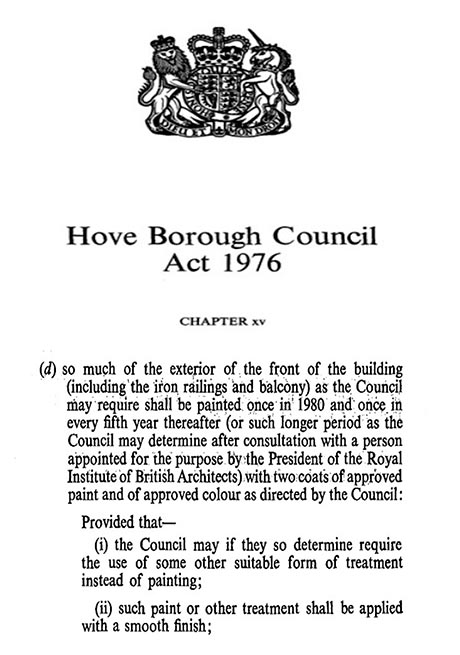
Extract of the 1976 act
2026 is painting year and Brighton and Hove City Council have stated that:
Re-painting of the historic properties in Brunswick Square and Terrace can go ahead as planned this year as council officers have worked with experts to identify a replacement product. Manufactured by Crown, the new ‘Brunswick Cream’ closely matches the previous colour. The repainting programme will also return to its original five-year schedule, after the council briefly extended the period to six years during the covid pandemic.
All of this work is paid for by the owners of the properties at some considerable expense but, hopefully, it does help maintain the uniformity of the glorious square and terraces as envisaged by the Brunswick Commissioners in 1830.
Research by Kevin Wilsher, October 2026