Sign up for our Newsletter
Our monthly newsletter lists our upcoming events, reviews, news from the Town House, history features and snippets, plus a local exhibition listing.
Contact Us
The Regency Town House
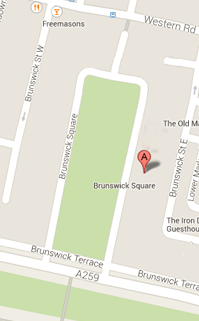
13 Brunswick Square
Brighton & Hove
East Sussex
BN3 1EH, UK
R-EX data General information
The Regency Town House was first occupied is around 1930. It was a single family home for many years, until in the early 20th century when it was divided into flats. This was very common with large houses like this one. It was only when Nick Tyson and his then partner bought the various flats in the 1980s and removed all the partitioning that the house was returned to being a single space once more.
The Regency Town House is privately owned. The restoration and running costs are funded entirely by our own activities. Funding comes mainly from historic building consultancy services and from venue hire for exhibitions and events. The income we generate is channelled through a charitable trust which, in return, has a right of access to the building. It is intended that, in time, the ownership of the building will pass to this charity.
The Regency Town House does not have a permanent cafe or restaurant. Our volunteers do sometimes operate a pop-up tearoom in our basement kitchen when we have other events taking place upstairs. This is very popular and the home-made cakes are especially delicious!
The Regency Town house has five storeys. The basement, ground floor, first floor (where the drawing rooms are), second floor and third floor. The drawing rooms are on the first floor. The servants' rooms and the kitchen are in the basement, the dining room and the parlour are on the ground floor, the drawing rooms are on the first floor and the bedrooms are on the second and third floors.
The drawing rooms are two rooms, the front drawing room and the rear drawing room, they are connected by a large, rectangular opening that once had folding doors. The front drawing room is 6.3 metres wide, 7.2 metres long, 4.1 metres high. The rear drawing room is 3.8 metres wide, 4.9 metres long, 4.1 metres high. The combined length of the two drawing rooms is around 11 metres. The overall length of the house is about twice this distance, more than 20 metres, becasue it extends back at basement level to include the kitchen and rear coal cellars to the rear, and forwards to include the front area and front coal cellars.
The front drawing room has three floor-to-ceiling sash windows. Each of these windows has louvred storm shutters on the outside. These would be lowered if stormy weather was forecast to protect the fragile window panes. The window panes were made of crown glass, which was very thin and fragile.
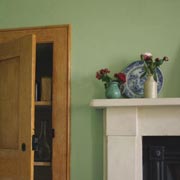
Each of the drawing rooms has a fireplace. These would have been identical.
The rear drawing room has a single sash window. It has shutters on the inside that can be rasied from a box beneath the window. These are to shade the furnishings from direct sunlight and to keep the room warmer at night.
Will the drawing rooms be finished, will they be decorated? We intend to reproduce the original finish in the drawing rooms. To do this, the original archaeology will be carefully preserved beneath lining paper, and then the original painted panel designs will be reproduced on top.
Things to see in the room today
The steel poles you can see hanging on the walls around the room are part of our picture hanging system. They are suspended from thin wires that are firmly anchored at the top of the wall. Pictures are then hung from the steel poles using nylon cords. The whole system is adjustable and can be removed completely. The picture hanging system removes the need to attach pictures directly to the walls, which would cause damage to the walls.
We use the picture hanging system when we have art exhibitions here. Most years we have between 12 and 20 exhibitions. We also host other events, including book launches, drama productions, meetup groups and life drawing classes.
By the window in the back drawing room there is a box piano. The piano dates from 1819, a few years before The Regency Town House was built. It is typical of the instruments that would have been in this room at that time. The piano is on loan to The Regency Town House.
Hanging from the ceiling centre in the front drawing room is a floral installation. This is not a permanent feature, but has been left in place since an event a few days ago. It will be taken down in the coming weeks, meanwhile, we think it looks rather nice.
The central heating radiators you can see were introduced in the late twentieth century.
The fireplace in the front drawing room is original, while the one in the rear drawing room was missing when we began the restoration. It has been temporarily replaced with a wooden mock-up and painted to match the one in the front drawing room.
The rugs on the floor in the front and rear drawing rooms are not original. They are late 20th century and help to make the floor softer underfoot and to deaden the sound in the room.