Sign up for our Newsletter
Our monthly newsletter lists our upcoming events, reviews, news from the Town House, history features and snippets, plus a local exhibition listing.
Contact Us
The Regency Town House
13 Brunswick Square
Brighton & Hove
East Sussex
BN3 1EH, UK
New Sussex Hospital for Women and Children, Windlesham Road Brighton
In the early 20th century, there were a number of hospitals in Brighton and Hove. In 1899 the Lewes Road Dispensary for Women and Children opened at 145 Islingword Road. Then, in 1905, the Lewes Road Hospital for Early Nervous Diseases of Women and Children opened at 101 Roundhill Crescent and Lady Chichester became a patron.
Lord Chichester (1871-1926) was Jocelyn Brudenall Pelham who lived in Stanmer House, Stanmer Park, Brighton. He inherited his title in 1905 and held a number of voluntary positions. For example, he was President of the Royal Alexandra Hospital for Children and also the Albion Home for Female Penitents. He died in 1926 aged 55 of influenza as did his eldest son 2 weeks later. His wife Ruth (née Buxton) (1875-1965) who he married in 1898 was also very involved with local causes. For example, as well as being President of the Lady Chichester Hospital she was President of the Brighton YMCA. Both Lord and Lady Chichester are buried in Stanmer Churchyard at Stanmer Park.
In 1911 The Lewes Road Dispensary moved to 4 Ditchling Road and both the hospital and dispensary become known as the Chichester Hospital and Dispensary for Women and Children. In 1912 this changed to the Lady Chichester Hospital and Dispensary. In 1913 the Lady Chichester Hospital (LCH) moves to 70 Brunswick Place and becomes the LCH Hove branch. The Ditchling Road hospital (now occupying numbers 4,6 and 8 Ditchling Road) becomes the LCH Brighton branch.
Finally, in 1918, the branches separate into two independent hospitals and the Brighton branch is renamed the New Sussex Hospital for Women and Children. In 1920 LCH Hove moves to Aldrington House.
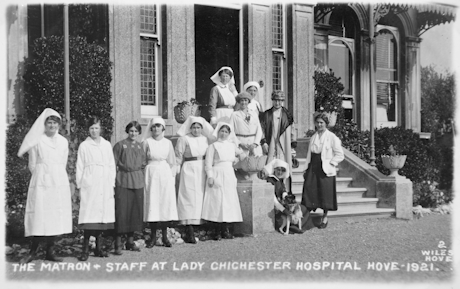
The Matron and staff at the Lady Chichester Hospital Hove 1921. Courtesy The Regency Society
In 1921 the New Sussex Hospital moves into Windlesham House. Windlesham House was built in 1843-44 as a school, and opened on the site in 1846. Its transformation into a hospital was largely due to the effort of Louisa Martindale, Elizabeth Robins and Octavia Wilberforce who were instrumental in raising funds to buy Windlesham House, this being the most suitable building available at the time.
The New Sussex Hospital opened in 1921 under the direction of Dr. Louisa Martindale, who was the daughter of the Louisa mentioned above.
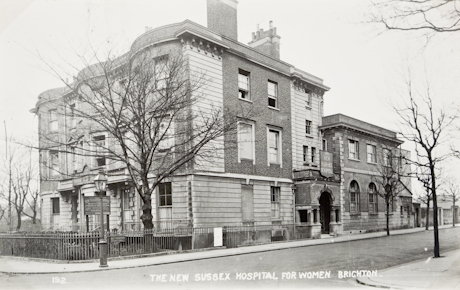
New Sussex Hospital for Women and Children photographed in the 1920s. Courtesy The Regency Society
Dr Louisa Martindale was Brighton’s first female GP and became senior surgeon at the New Sussex. Amongst other achievements Louisa pioneered the early treatment of cervical cancer, uterine cancer and fibroid growths with intensive X-ray therapy, researched venereal disease and carried out over 7,000 operations.
The New Sussex Hospital for Women and Children was entirely staffed by women, including Maud Griffith who lived at 13 Brunswick Square. The hospital was extended to the west and to the north in the late 1920s and 1930s.
In the 1980s the New Sussex became a psychiatric hospital. Diana Joll, the last resident of number 13, would have been familiar with it. It remained in hospital use until 1998 when it was converted to flats known now as Temple Heights.
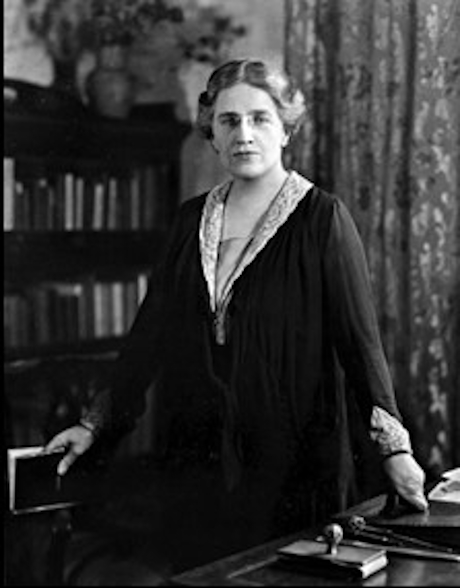
Dr Louisa Martindale 1872-1966
Photograph: Crucible Royal Sussex County Hospital which has a new building named after Louisa
Reference: Val Brown, Women’s Hospitals in Brighton and Hove 2006. The Hastings Press
Research by Jill Vigus 2024